
Constructivism was an artistic and architectural philosophy that originated in Russia beginning in 1913 by Vladimir Tatlin. This was a rejection of the idea of autonomous art. He wanted ‘to construct’ art. The movement was in favour of art as a practice for social purposes.
Constructivism had a great effect on modern art movements of the 20th century, influencing major trends such as the Bauhaus and De Stijl movements. Its influence was widespread, with major effects upon architecture, sculpture, graphic design, industrial design, theatre, film, dance, fashion and, to some extent, music.
The term Construction Art was first used as a derisive term by Kazimir Malevich to describe the work of Alexander Rodchenko in 1917. Constructivism first appears as a positive term in Naum Gabo’s Realistic Manifesto of 1920. Aleksei Gan used the word as the title of his book Constructivism, printed in 1922.

In 1919 Beat the Whites with the Red Wedge by El Lissitzky, repurposed abstract Suprematist motifs as war propaganda. The lithograph shows a huge red triangle that pierces into a white circle, which creates the center of attention. The red wedge symbolized the revolutionaries, who were penetrating and killing the anti-Communist White Army. The white background depicts a bright future.
The Constructivists rejected the idea of art being autonomous from the rest of society, to them, all art and design was a political tool. In short, Russia was their canvas, the building of the new Soviet nation an art project of gigantic scale.
The issue initially was, how do we communicate with a population that was for the most part illiterate. That is were symbolism came into its own, enabling the Communist to give a clear message by symbolism.
By 1924 The government of the time saw the benefits of a population that could read and write Alexander Rodchenko and Varvara Stepanova’s famous Books! poster (1924) employs a stark grammar of simple geometry and flat colour to promote a campaign for worker education.


Later that year Lissitzky pioneered the collage of purely photographic images,many decades before Photoshop
This was probably the start of what we have come to know as Graphic design. The Constructivists applied this abstract visual grammar with remarkable consistency across a wide range of design disciplines.
Early Soviet graphic design consists of an unlikely mix of high avant-garde theory and political propaganda.
The Constructivist experiment was stopped in its tracks when government power struggles following the death of Lenin in 1924 ended in Stalin’s dictatorial rule.

The Stalinists considered the Constructivist aesthetic too rarefied to serve as an effective instrument of state propaganda, ruling that all future design should abide by the conservative neoclassical style of Socialist Realism.
Constructivist designers who refused to co-operate retired from public life, fled Russia, or received a visit from state police in the early hours of the morning and ended up in the Gulag.
During the days of Stalin, one wrong word could end with the secret police at your door, ready to drag you off to a Soviet gulag – one of the many forced labour camps where inmates worked until they died. Historians estimate that nearly 14 million people were thrown into a gulag prison during Stalin’s reign. The families of priests, professors, and important figures would be rounded up and sent off to the work camps, keeping them out of the way while the Soviet Union systematically erased their culture.

Gustav Klutsis One of the pioneers of Soviet propaganda graphic design was particularly prominent for his revolutionary use of photomontage to create political posters, book designs, newspaper and magazine illustrations.
Starting from 1929 he worked on the Struggle for a Five-Year Plan series of photomontages and posters that would become classics of Soviet design just like his earlier Lenin series. His works of this period often combine methods of posed photography, reportage and double-exposure images.
By the mid 1930s he was one of the leading exponents of propaganda art, however his relationship with the authorities was gradually deteriorating, particularly with IZOGIZ, the Soviet publisher of mass propaganda. The last major exhibition he participated in and helped to organize was the Soviet Pavilion at the 1937 Paris World Exhibition.
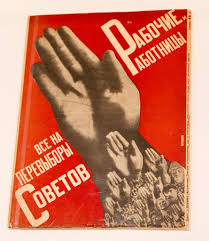

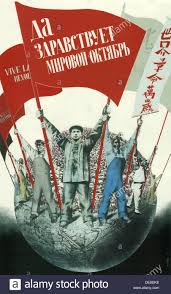
Like so many others, on 17 January 1938, Klutsis was secretly arrested and had disappeared into a system of paranoia and repression. The creativity that marked his life stood in stark contrast to an oppressive state and those two ideas could not coexist for very long. It was not until 1989 that the records of Klutsis’s assassination were revealed
 The Graphics Guy